
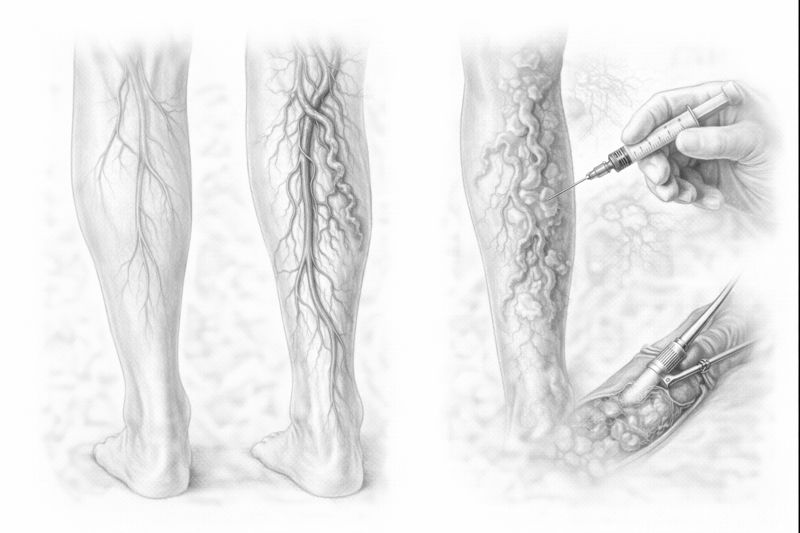
How Do Varicose Veins Form? (Valve Problem)
The function of veins is to carry deoxygenated blood from the body upwards, against gravity, to the heart. To perform this challenging task, “one-way valves” (check-valves) are located inside the veins to prevent blood from flowing backward.
When these valves malfunction due to genetic predisposition, age, or occupational reasons, blood cannot flow upwards and begins to pool downwards. With increased pressure, the vein wall expands, twists, and protrudes to the skin surface. This condition is called varicose veins.
Types of Varicose Veins: From Capillary to Large
Varicose veins are divided into three groups based on their size and location:
- Capillary Varicose Veins (Telangiectasia): These are red-purple veins, thinner than 1 mm, resembling a spider web. They usually cause aesthetic problems and are not painful.
- Medium-Sized Varicose Veins (Reticular): These are green-blue veins, slightly raised from the skin, with a diameter of 2-4 mm. They are frequently seen behind the knee.
- Large Varicose Veins (Truncal): These are finger-thick, twisted “bundles” of veins protruding from the skin. These are the varicose veins that require actual treatment due to insufficiency.
What Causes Them? Risk Factors
- Genetics: If a parent has varicose veins, there is a 70-80% chance of their child developing them.
- Occupation: Teachers, surgeons, hairdressers, waiters, and those who stand for long periods, or desk workers, are at risk.
- Pregnancy: Hormonal changes and increased blood volume dilate the veins.
- Obesity: Excessive weight increases intra-abdominal pressure, making it harder for blood to return from the legs.
- Heat: Hot environments like Turkish baths, saunas, and thermal springs dilate veins and worsen symptoms.
Hidden Signals in the Legs: Symptoms
Varicose veins are not just a cosmetic defect. The following symptoms, which worsen throughout the day, are typical:
- Leg pain and a feeling of heaviness that increases towards the evening.
- Swelling (edema) in the ankles and sock marks remaining.
- Night leg cramps.
- Itching and burning sensation in the legs.
- A desire to move the legs, similar to restless legs syndrome.
Advanced Stage: If left untreated, darkening of the skin around the ankle (hyperpigmentation) and non-healing wounds (venous ulcers) may occur.
Diagnostic Methods: Doppler Ultrasound
Visual examination is not sufficient. To detect main vein insufficiency, which is the “unseen part of the iceberg,” a Standing Color Doppler Ultrasonography should be performed. This examination shows which vein has leakage, the degree of leakage, and the vein diameter in millimeters. The treatment plan is then drawn up accordingly.
Current Treatment Methods
Painful and stitched surgeries of the past have now been replaced by modern methods. The goal is not to remove the faulty vein from the body, but to close and disable it in place.
1. Laser and Radiofrequency (EVLA/EVRF)
A thin catheter is inserted into the vein. The vein wall is heated and cauterized with laser or radiofrequency energy, causing the vein to shrink and close. General anesthesia is not required, and the patient can walk home the same day.
2. Biological Adhesive (Glue) Method
This is one of the newest methods (VenaBlock, etc.). Tissue adhesive (cyanoacrylate) is injected into the vein, causing it to immediately seal. Since no heat is used, anesthesia is not necessary, and there is no obligation to wear compression stockings after the procedure.
3. Foam and Injection Treatment (Sclerotherapy)
Used for thinner and medium-sized varicose veins. A constricting agent (in liquid or foam form) is injected into the vein. The vein is gradually absorbed and eliminated by the body. The aesthetic results are very good.
4. Surgery (Stripping)
In rare cases where the vein diameter is excessively large or modern methods cannot be applied, classic surgery may be required to remove the vein.
Ways to Prevent Varicose Veins
- Do not stand or sit still for long periods; every hour, perform “pedal movements” by rising and lowering on your toes.
- In the evenings, rest your legs for 15-20 minutes by elevating them above heart level.
- Avoid heat; at the end of a shower, rinse your legs with cold water.
- Engage in sports that work the leg muscles, such as swimming and walking.
Do you have questions about varicose veins?
You can review the special page we have prepared for detailed answers to all your questions about varicose vein treatment, recovery process, risk factors, and anything else on your mind.


