
When the vessel diameter reaches a critical level, it can suddenly rupture, creating a life-threatening situation. This disease, which has been the cause of death for many famous historical figures from Albert Einstein to Charles de Gaulle, can now be successfully treated thanks to modern screening methods and EVAR (Endovascular Aneurysm Repair) technology.
Anatomy: The Main Abdominal Artery
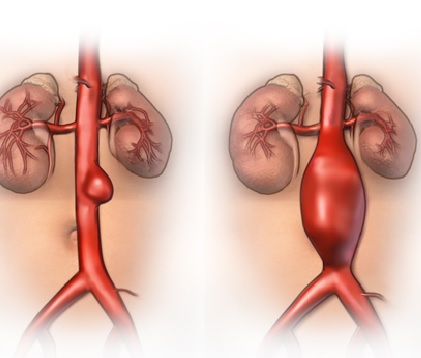
After leaving the heart, the aorta passes through the chest cavity and enters the abdominal cavity. After giving off the renal arteries, it divides into two (iliac arteries) at the level of the navel and goes to the legs. This region is called the Abdominal Aorta.
[Image of abdominal aorta anatomy]
Normally the width of a garden hose (approximately 2 cm), this vessel can reach the size of an orange (5-6 cm and above) when an aneurysm develops. As the wall thins, the risk of rupture due to blood pressure increases.
Why Does It Occur? (Smoking and Genetics)
The destruction of elastic fibers in the vessel wall leads to an aneurysm. The biggest culprits are:
- Smoking: This is undeniably the biggest risk factor. Smoking destroys the proteins that support the aortic wall. 90% of aneurysm patients have a history of smoking.
- Advanced Age and Gender: Much more common in men over 65. It is rarer in women, but when it occurs, the risk of rupture is higher.
- Genetic Predisposition: The risk increases by 20-25% in those with a first-degree relative (father, brother) who has had an aneurysm.
- Atherosclerosis and Hypertension: Hardening of the arteries and high blood pressure weaken the vessel wall.
“Heart Beating in My Abdomen”: Symptoms
Most patients are unaware of their condition until they undergo an ultrasound or tomography for another reason. However, observant patients may feel the following:
- Pulsation Sensation: When lying on your back and placing your hand on your abdomen, you may feel a “pulsating mass like a heart” around your navel.
- Abdominal and Back Pain: A constant, dull, deep pain that does not subside with changes in position.
- Feeling of Fullness: Large aneurysms can press on the stomach, leading to early satiety.
Diagnosis and Screening Programs
Diagnosis is quite simple:
- Abdominal Ultrasound (USG): A radiation-free, painless, and quick screening test. It is recommended that every man over 65 with a history of smoking get screened once in their lifetime.
- CT Angiography: When a treatment decision is made, it is the gold standard for millimeter-accurate measurement of the vessel diameter and to assess suitability for stent (EVAR) placement.
Treatment Options
Not every aneurysm is operated on. Treatment is like a “balancing act”; the risk of surgery is weighed against the risk of rupture.
1. Watch and Wait (Follow-up)
If the aneurysm diameter is below 5.0 – 5.5 cm, the risk of rupture is low. The patient is followed up with ultrasound every 6 months. Smoking cessation is encouraged, and blood pressure is controlled.
2. Endovascular Method (EVAR)
This is Endovascular Aortic Repair, commonly known as the “non-surgical method,” applied to 70-80% of patients today.
- How is it done? A small incision or needle entry is made through the groin. A fabric-covered metal tube (Stent-Graft) is placed inside the aneurysm, through which blood will flow. This way, the pressure is exerted on this artificial vessel, not on the weakened vessel wall.
- Advantage: The abdomen is not opened, general anesthesia (sometimes) is not required, and the patient is discharged the next day.
3. Open Surgery
This is preferred for patients whose anatomy is not suitable for EVAR or for very young patients. The abdomen is opened, the enlarged vessel is cut, and an artificial vessel is sewn in its place. The recovery period is longer, but it is a permanent solution for life.
Emergency: Symptoms of Rupture
If an aneurysm ruptures, the situation can be fatal within minutes. In the presence of the following symptoms, 112 should be called immediately:
- Sudden, stabbing, severe pain radiating to the back and sides.
- Sudden drop in blood pressure, blurred vision, fainting.
- Cold sweats and signs of shock.
Frequently Asked Questions (FAQ)
When is surgery decided?
As a general rule, intervention is performed when the aortic diameter exceeds 5.5 cm in men and 5.0 cm in women. Additionally, if there is rapid growth of more than 0.5 cm in 6 months, even if the diameter is small, surgery is required.
Can EVAR (Endovascular method) be applied to everyone?
No. For EVAR to be performed, the neck of the vessel and the groin vessels must be of suitable structure. If the patient’s anatomy is suitable based on measurements taken with tomography, EVAR is the first choice.
Can an aneurysm shrink with medication?
No, an enlarged vessel does not return to its original state with medication. Medications can only slow down growth and reduce the risk of rupture. Definitive treatment is mechanical repair.
Is sexual life affected after surgery?
In open surgery, retrograde ejaculation (sperm entering the bladder) may rarely occur due to the involvement of nerves around the aorta. In the EVAR method, this risk is almost negligible. Generally, normal sexual life can be resumed after recovery.
Conclusion
Abdominal aortic aneurysm is an insidious disease that can be treated if diagnosed early. Screening with a simple ultrasound, especially for men over 65 and smokers, is life-saving. Thanks to EVAR technology, it is now possible to neutralize this “ticking time bomb” with a small procedure performed through the groin, without the need for major surgery.


