
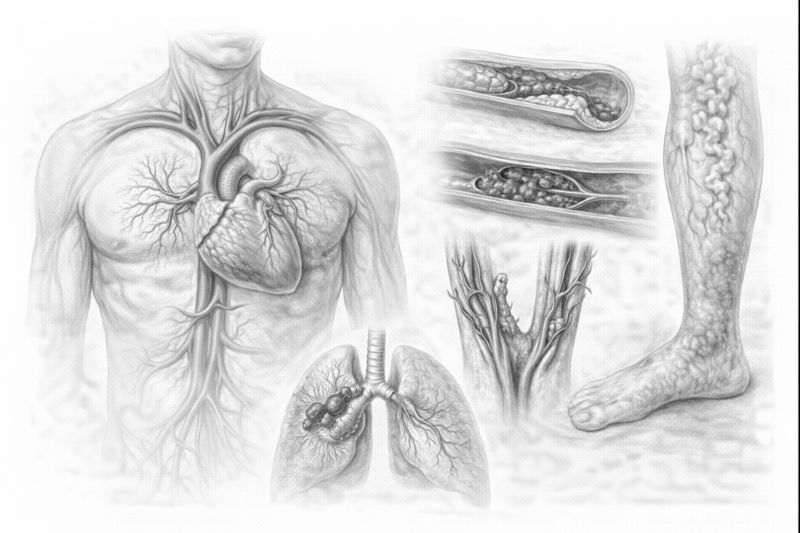
What Is the Vascular System? The Difference Between Arteries and Veins
The circulatory system in our body consists of two main types of vessels:
- Arteries: These are thick-walled, muscular vessels that carry oxygen- and nutrient-rich clean blood from the heart to the farthest points of the body. They operate under high pressure.
- Veins: These are thinner-walled vessels that collect deoxygenated blood containing carbon dioxide and waste products from the organs and return it to the heart. They contain valves that prevent the backflow of blood.
The causes, symptoms, and treatments of diseases in these two systems differ from one another.
Most Common Vascular Diseases
1. Peripheral Artery Disease (Leg Vascular Blockage)
It is the narrowing or blockage of the arteries supplying the legs, usually due to atherosclerosis (hardening of the arteries). As blood flow decreases, tissues cannot receive adequate nourishment.
- Symptoms: The most typical symptom is pain that begins in the calf during walking or exercise, may spread to the hip, and subsides with rest (intermittent claudication). In advanced stages, rest pain, coldness, pallor, color changes in the feet, and non-healing wounds (ulcers) occur. If left untreated, it can lead to gangrene and limb loss.
2. Carotid Artery Disease (Carotid Artery Blockage)
It is the narrowing of the carotid arteries — located on both sides of the neck and responsible for carrying blood to the brain — due to atherosclerotic plaques. Small particles breaking off from these plaques, or clots forming in the narrowed area, can travel to the brain and cause temporary or permanent paralysis (stroke).
- Symptoms: It usually progresses insidiously and the first sign may be a transient ischemic attack (TIA) or a full stroke. TIA symptoms include neurological findings that resolve within 1-2 hours, such as sudden weakness in the face, arm, or leg, speech impairment, and sudden vision loss in one eye.
3. Deep Vein Thrombosis (DVT)
It is the formation of a blood clot (thrombus) in the deep veins of the body, particularly in the legs. This clot blocks the vessel and prevents the return of blood.
- Symptoms: It typically presents with swelling, pain, warmth, and redness in one leg. The greatest danger is the clot breaking loose and traveling through the bloodstream to the lungs, causing a life-threatening condition called Pulmonary Embolism. Pulmonary embolism presents with symptoms such as sudden shortness of breath, chest pain, and bloody sputum.
4. Varicose Veins and Chronic Venous Insufficiency
It is the failure of the valves inside the superficial veins of the legs to pump blood effectively toward the heart, causing blood to flow backward and pool in the vessels. This leads to the veins becoming enlarged, twisted, and visibly prominent.
- Symptoms: Beyond cosmetic concerns, it causes pain, heaviness, fatigue, night cramps, and itching in the legs. In advanced cases, permanent swelling around the ankle, skin discoloration (brown-purple patches), and difficult-to-treat venous ulcers (varicose wounds) may develop.
5. Vasculitis (Inflammation of the Vessel Wall)
Vasculitis is not a single disease, but rather a collective term for a group of autoimmune conditions in which the body’s own immune system mistakenly attacks the vessel walls. This attack can cause inflammation, thickening, narrowing, and even blockage of the vessel walls. It can affect large, medium, or small caliber vessels (both arteries and veins).
- Causes and Mechanism: Unlike atherosclerosis, inflammation is at the core of vasculitis. It has many subtypes, including Behçet’s Disease, Takayasu Arteritis (“pulseless disease”), Giant Cell Arteritis, and Buerger’s Disease. Although the exact causes are not fully known, genetic and environmental factors are thought to play a role.
- Symptoms: They vary greatly depending on the affected vessel and organ. In addition to general symptoms such as fever, weight loss, and fatigue, specific findings may include skin rashes, joint pain, numbness due to nerve damage, eye inflammation, and kidney dysfunction. Buerger’s disease in particular causes severe pain and wounds in the fingers of young male smokers.
- Diagnosis and Treatment: Diagnosis is made through blood tests (inflammatory markers), imaging methods, and vessel biopsy for definitive confirmation. The foundation of treatment consists of medications that suppress the immune system, particularly corticosteroids and other immunosuppressive agents.
Causes and Risk Factors of Vascular Diseases
Risk factors for arterial and venous diseases generally differ:
- Main Risks for Arterial Diseases: Smoking (the most important factor), high blood pressure (hypertension), elevated blood lipids (cholesterol, triglycerides), diabetes, obesity, sedentary lifestyle, and family history.
- Main Risks for Venous Diseases: Genetic predisposition, advanced age, female gender, pregnancy, occupations requiring prolonged standing or sitting, obesity, previous leg trauma or major surgeries, and hormone therapies.
- Risks for Vasculitis: Generally uncertain, but genetic predisposition, certain infections, and smoking (particularly for Buerger’s Disease) may play a role.
Symptoms by Disease: When Should You Be Suspicious?
- Leg pain when walking: Peripheral artery disease.
- Sudden swelling and pain in one leg: Deep vein thrombosis (DVT).
- Sudden speech impairment, facial drooping: Stroke due to carotid artery disease.
- Unexplained fever, weight loss, and skin rashes: Vasculitis.
- Non-healing wound and discoloration around the ankle: Chronic venous insufficiency or advanced peripheral artery disease.
- Blue-purple, twisted veins in the legs: Varicose veins.
How Is Vascular Disease Diagnosed?
Following a physical examination, modern imaging methods are utilized for accurate diagnosis:
- Color Doppler Ultrasonography: A harmless and the most fundamental diagnostic method that uses sound waves to visualize blood flow and vascular structure. Used in the initial evaluation of varicose veins, DVT, peripheral artery disease, and carotid artery disease.
- CT/MR Angiography: Advanced imaging methods that create a detailed three-dimensional map of the vessels using contrast agents. Critical for planning surgical or endovascular treatment.
- Conventional Angiography (DSA): A gold standard method performed by injecting contrast agent directly into the vessel via a catheter inserted through the groin, offering both diagnosis and same-session treatment (balloon/stent).
- Ankle-Brachial Index (ABI): A simple test performed by measuring blood pressure at the arm and ankle to assess the degree of leg vascular blockage.
- Blood Tests and Biopsy: When vasculitis is suspected, measuring inflammatory markers (CRP, ESR) and taking a tissue sample (biopsy) from the affected vessel may be required for definitive diagnosis.
Treatment Approach: From Lifestyle to Surgery
Treatment is personalized according to the type and stage of the disease and the patient’s overall condition.
1. The First Step: Lifestyle Changes
These form the foundation of treatment for all vascular diseases: complete cessation of smoking, regular exercise (especially walking), a Mediterranean-style diet, weight management, and regulation of blood sugar and blood pressure.
2. Medical Treatments
- Blood Thinners: In arterial diseases, antiplatelet agents (Aspirin, Clopidogrel) are used; in DVT and pulmonary embolism, anticoagulants that prevent blood clotting are used.
- Cholesterol-Lowering Agents (Statins): Used to slow atherosclerosis and stabilize plaques.
- Immunosuppressants (Immune Suppressors): The cornerstone of vasculitis treatment. Corticosteroids and other agents are used to bring the inflammatory response under control.
- Venous Tonic Medications: Used to relieve the symptoms of varicose veins and venous insufficiency (pain, swelling).
3. Minimally Invasive (Endovascular) Interventions
These are modern methods performed under angiographic guidance that do not require general anesthesia or large incisions:
- Balloon Angioplasty and Stent: The widening of narrowed or blocked arteries (leg, carotid) using a balloon, and the placement of metal mesh tubes (stents) to prevent re-narrowing.
- Laser/Radiofrequency Ablation: Inserting a thin catheter into the varicose vein and closing it from the inside using thermal energy.
4. Open Surgical Methods
Applied in cases that are not suitable for endovascular methods or have progressed significantly:
- Bypass Surgery: Creating a bridge using a vessel taken from another part of the body or a synthetic graft to carry blood past the blocked artery.
- Endarterectomy: The surgical scraping and removal of the atherosclerotic plaque blocking the vessel (most commonly performed on the carotid artery).
- Varicose Vein Surgery (Stripping): The surgical removal of a varicose vein that has become non-functional.
Prevention and Protection Methods
The most effective way to protect vascular health is to keep risk factors under control. Leading an active lifestyle, avoiding cigarettes and tobacco products, maintaining a healthy weight, and effectively managing chronic conditions such as diabetes and hypertension significantly reduce the risk of developing vascular diseases.
Conclusion
Vascular diseases are a common health problem that seriously affects quality of life and can lead to life-threatening consequences if left untreated. However, thanks to the possibilities offered by modern medicine today, the majority of these conditions can be successfully managed through accurate early diagnosis and individually tailored treatment strategies. Listening to the signals your body gives and taking abnormal symptoms — particularly those appearing in the legs or neurological functions — seriously, then promptly consulting a Cardiovascular Surgery specialist or a relevant specialist (Rheumatology, Neurology) without delay, is the most important step toward a healthy circulatory system and a quality life.


