
What Are Endovascular and Transcatheter Interventional Treatments?
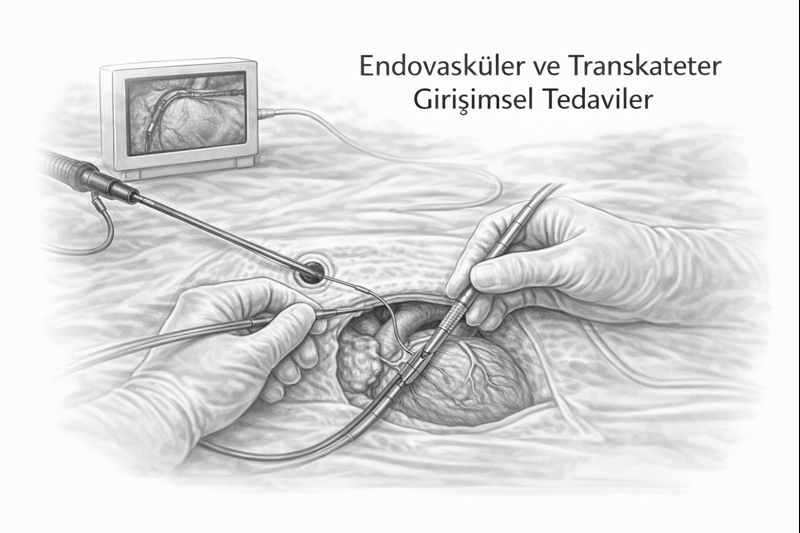
These terms describe procedures performed without open surgery, by advancing through blood vessels. “Endo” means inside, “vascular” refers to vessels, and “transcatheter” refers to interventions performed through thin, flexible tubes called catheters. Unlike conventional surgery, these methods do not require cutting the sternum or making large skin incisions. Surgeons or interventional cardiologists insert specialized catheters (thin tubes advanced over guidewires) through a very small puncture — typically at the groin, wrist, or neck — and advance them to the heart or the relevant vascular region.
How Do They Work? Basic Principles
Catheter Guidance: The procedure is typically performed under live imaging techniques such as X-ray (fluoroscopy) or ultrasound, allowing the physician to monitor the catheter’s advancement through the body in real time on a screen.
Reaching the Target: Once the catheter reaches the heart or the affected vascular area, treatment is performed using specialized tools at its tip (balloons, stents, valves, closure devices, etc.).
Minimal Trauma: This approach minimizes tissue damage and eliminates the large scars and lengthy recovery periods associated with conventional surgery.
Main Areas of Application
Endovascular and transcatheter techniques are successfully used in the treatment of many different cardiovascular diseases.
Coronary Angioplasty and Stenting
What it is: One of the most common interventional methods used to open blocked or narrowed coronary (heart-supplying) arteries.
How it is performed: A catheter inserted through the groin or wrist reaches the blocked vessel. First, a balloon-tipped catheter is inflated to open the vessel (angioplasty), then a stent (small metal mesh) is placed to prevent re-narrowing.
TAVR (Transcatheter Aortic Valve Replacement)
What it is: Placement of a new aortic valve via catheter in patients with severe aortic stenosis who are at high risk for or unsuitable for open-heart surgery.
How it is performed: A small incision is made, typically in the femoral artery of the groin or less commonly in the chest wall. The compressed artificial valve at the catheter tip is advanced to the heart and deployed inside the existing valve.
MitraClip / TriClip
What it is: An interventional method in which a small clip is placed in patients with mitral or tricuspid valve regurgitation (backflow) to ensure complete closure of the valve leaflets.
How it is performed: Access to the heart is gained through the groin vessel, and clips are attached to the valve leaflets under echocardiography (cardiac ultrasound) guidance to reduce regurgitation. This is a less invasive valve repair compared to open surgery.
Aortic Aneurysm Repair (EVAR/TEVAR)
What it is: A method of repairing aneurysms (bulges) in the aorta, the body’s main artery, by placing a stent graft inside the vessel. EVAR is used for the abdominal aorta, while TEVAR is used for the thoracic aorta.
How it is performed: A catheter inserted through the femoral artery reaches the aneurysm site, and a stent graft is placed to isolate the aneurysm from blood flow and reduce the risk of rupture.
PFO/ASD/VSD Closure (Treatment of Congenital Heart Defects)
What It Is: The repair of congenital holes in the heart (such as Patent Foramen Ovale – PFO, Atrial Septal Defect – ASD, Ventricular Septal Defect – VSD) using specialized closure devices via catheter.
How It Is Done: Access is typically gained through the groin vessel to reach the hole in the heart, and specially designed umbrella-like devices are deployed to close the opening.
Advantages of Endovascular Treatments
- Less Invasive: No large surgical incision or opening of the breastbone is required — only a small skin puncture is needed.
- Faster Recovery: Hospital stay is shorter, and patients can return to daily activities more quickly.
- Less Pain: Post-operative pain is generally milder compared to traditional surgery.
- Lower Blood Loss: The need for blood transfusion is reduced.
- Aesthetic Outcome: Instead of large scars, only a small puncture mark remains.
- Suitability for Elderly and High-Risk Patients: Often provides a treatment option for elderly patients or those with additional conditions who are considered too high-risk for traditional open surgery.
Who Is It Suitable For?
Endovascular and transcatheter treatments may not be suitable for everyone. The most appropriate treatment method is determined by evaluating many factors such as the patient’s general health condition, the type and severity of the disease, and vascular structure. These methods are frequently preferred especially for elderly patients, those with more than one chronic disease, or high-risk patients who have undergone previous surgeries.
Recovery Process
The recovery process after interventional treatments is much faster compared to traditional surgery. Most patients are discharged from the hospital within a few days. There may be mild pain or bruising at the entry site. After a short rest period, patients can return to their normal daily activities. However, strictly following the doctor’s instructions (medication use, physical activity restrictions, etc.) is of critical importance for a successful recovery.
Summary: Frequently Asked Questions (FAQ)
Is anesthesia used during these procedures?
Are the effects of these procedures permanent?
How long do I need to stay in the hospital?
Are there risks associated with endovascular treatments?
When can I return to normal life after the procedure?
Are the effects of these procedures permanent?
Do You Have Questions About Endovascular Treatments?
For answers to 25 questions you may have about the risks, advantages, and recovery periods of TAVI, EVAR, TEVAR and other minimally invasive methods, you can visit our dedicated page.
Conclusion
Endovascular and transcatheter interventional treatments offer groundbreaking, patient-centered approaches in the treatment of cardiovascular diseases. Their less invasive nature, faster recovery times, and lower risk factors compared to conventional surgery have made them a preferred treatment option for many patients. However, it should not be forgotten that, like any treatment method, these techniques may not be suitable for every patient.

