
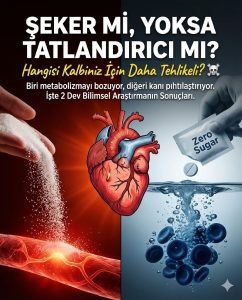
There’s a common saying: “Escaping the rain only to be caught in the hail,” which describes avoiding one danger only to encounter a greater one. Unfortunately, this is precisely what we are experiencing with our modern eating habits, especially concerning our heart health.
For decades, we’ve been taught that sugar merely “causes weight gain,” “rots teeth,” or, at worst, leads to diabetes. With this superficial understanding, we believed that avoiding sugar was the key to good health. However, cardiology and metabolic science have proven that the real danger isn’t just the fat accumulating around our waists, but a silent, insidious process progressing deep within our blood vessels.
So, with this awareness, what about those seemingly “innocent” havens we’ve sought refuge in after avoiding sugar? Are the labels “Sugar-Free,” “Diet,” “Zero,” or “Keto-Friendly” on packages truly safe shelters, or do they herald a fiercer storm awaiting us?
In this comprehensive article, we delve into the sugar or sweetener dilemma, illuminated by two groundbreaking scientific studies that have sent shockwaves through the cardiology world and fundamentally shaken nutritional paradigms. We examine, with evidence-based medical data, which poses a more insidious, greater, or more sudden threat to your heart.
Act 1: The Sugar Trap and the Silent Fire in Your Vessels
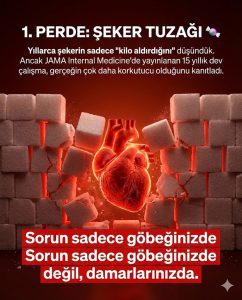
What we knew about the harms of sugar was just the tip of the iceberg. A massive study published in the prestigious medical journal JAMA Internal Medicine, which followed tens of thousands of participants for 15 years, revealed that the truth is far more frightening.
When added sugar (sucrose and high-fructose corn syrup) enters the body, it doesn’t just create excess calories. Metabolized in the liver, it tends to convert directly into fat (de novo lipogenesis). This raises blood fats (triglycerides), lowers good cholesterol (HDL), and leads to fatty liver.
But more importantly, high blood sugar initiates a rusting process we call “oxidative stress” in the blood vessel walls and triggers a chronic, low-grade inflammation process. This inflammation forms the basis of atherosclerosis. In other words, sugar is like an insidious enemy that gnaws at your blood vessels from within.
You’re at Risk Even If You Don’t Gain Weight
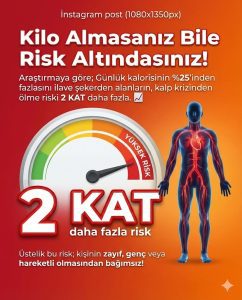
The most striking and paradigm-shifting finding of this research was that the damage sugar inflicts on the heart is largely independent of your weight.
According to the data, individuals who derive more than 25% of their daily calories from added sugar have 2 TIMES higher risk of dying from cardiovascular diseases (heart attack, stroke) compared to those who keep this ratio below 10%. Moreover, this increased risk exists regardless of whether the person is thin, young, or physically active.
Therefore, the idea that “I don’t gain weight, so I can eat as much sugar as I want” is a fatal misconception for your heart. The problem isn’t just around your waistline, but directly in the walls of the vital blood vessels that nourish your organs.
The Wrong Escape: The “Sugar-Free” Deception and a New Danger
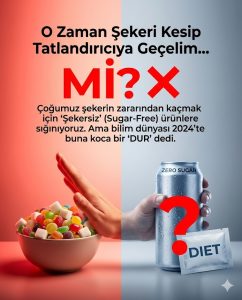
Many people with high health consciousness, learning about the chronic and insidious harms of sugar, turned to the “alternatives” offered by the industry as a solution. Labels like “Diet,” “Light,” “Zero Sugar,” or “Sugar-Free” on packages seemed like saviors that eased our consciences. We gave up sweets and sought refuge in artificially sweetened diet drinks, “fit” desserts, sugar-free chewing gum, and even toothpastes.
However, in 2024, the scientific world put a big “STOP” to this mass exodus. We had escaped the rain, but now we were about to be caught in a much harsher, sharper, and more sudden hail.
Act 2: The Sweetener Reality and the Risk of Sudden Clotting
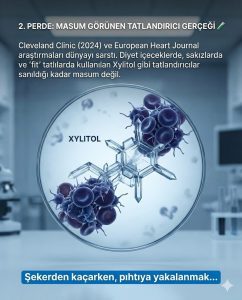
A groundbreaking study conducted by the Cleveland Clinic Lerner Research Institute and published in 2024 in the European Heart Journal, one of the most respected journals in cardiology, shook the world. This study revealed that sugar alcohols (polyols), frequently used in diet drinks, chewing gum, toothpastes, “keto” products, and “healthy” snacks, are not as innocent as believed, and can even be biologically active and dangerous.
The substances under scrutiny were sweeteners like Xylitol and Erythritol, which are naturally found in very small amounts in some fruits and vegetables but are industrially produced from corn and added to foods in high quantities.
While sugar causes chronic damage by disrupting metabolism in the long term, it was understood that these sweeteners trigger a much more acute and sudden risk in the blood.
Xylitol and the “Sticky” Blood Danger: How Does the Mechanism Work?
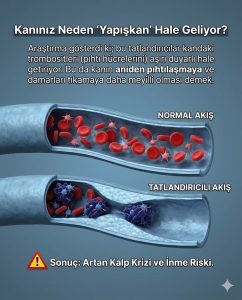
So, how do these “calorie-free” and supposedly “innocent” sweeteners cause harm? The mechanism is quite frightening and directly related to our blood’s clotting system.
Researchers discovered that when sweeteners like Xylitol reach high levels in the blood (for example, after drinking a sweetened beverage), they make blood platelets, called thrombocytes, hypersensitive. The main function of platelets in the body is to come together and form a clot to stop bleeding in case of an injury. This is a vital defense mechanism.
However, Xylitol stimulates receptors on the surface of platelets, making them excessively “alert” and “sticky.” This facilitates spontaneous clot formation within the blood vessel. Even a minor trigger that would not normally cause a clot can turn into a vessel-blocking clot in this “hyperactive” environment.
As a result, the blood becomes much more prone to clotting in the vessels. This significantly increases the risk of sudden heart attack (myocardial infarction) and stroke.
Comparative Analysis: A Double-Edged Sword

In summary, there is no single answer to the question, “Is sugar or sweetener more harmful?” It’s like holding a double-edged sword. Neither is safe for your heart health; they simply differ in their methods and timing of harm.
- 🔴 SUGAR (Chronic Risk): Over years, it causes slow damage. It disrupts metabolism, leads to insulin resistance, causes fatty liver, raises blood pressure, and increases systemic inflammation, paving the way for atherosclerosis. The result is long-term chronic damage.
- 🔵 SWEETENER (Acute Risk): Its effect can be more sudden. It makes the blood “sticky,” triggers platelet activation, and creates a risk of thrombosis (clotting). The result can be an acute event (crisis, stroke) that develops suddenly in an existing vascular problem.
So What Should We Do? Heart-Friendly Solutions
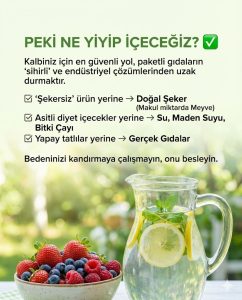
In light of this information, instead of despairing, we must make conscious choices. The safest path for your heart is to stay away from packaged, processed, and supposedly “magical” solutions offered by the industry. Don’t try to trick your body with chemicals; nourish it with real foods provided by nature.
Here are heart-friendly, actionable, and simple changes:
- Natural Sugar instead of “Sugar-Free” products: Satisfy your sweet cravings with fresh fruits (in reasonable amounts) where the fiber matrix is intact, instead of industrial bars or artificial sweeteners. The fiber in fruit slows down sugar absorption, reducing metabolic damage.
- Water instead of carbonated and diet drinks: Water is the best and only option to quench your thirst. You can add variety with plain mineral water, herbal teas (unsweetened), or natural flavors like lemon/mint.
- Real Foods instead of artificial sweets: Choose unprocessed, unpackaged foods whose ingredients you know. Develop the habit of reading labels; think twice when you see ingredients like Xylitol, Erythritol, Sorbitol, Maltitol.
Scientific Sources and Evidence-Based Medicine
The information shared in this article is not personal opinion but is based on current peer-reviewed clinical studies published in the most prestigious journals of cardiology literature:
- Sugar Study: Yang Q, et al. Added Sugar Intake and Cardiovascular Diseases Mortality Among US Adults. JAMA Internal Medicine. 2014;174(4):516-524. (A foundational study demonstrating the relationship between added sugar intake and cardiovascular mortality risk.)
- Sweetener Study: Witkowski M, et al. Xylitol is prothrombotic and associated with cardiovascular risk. European Heart Journal. 2024 Jun;ehae244. (A current study revealing the prothrombotic effect of Xylitol and its association with cardiovascular risk.)
- Erythritol Study: Witkowski M, et al. The artificial sweetener erythritol and cardiovascular event risk. Nature Medicine. 2023;29:710–718. (A study showing that Erythritol also poses a risk through a similar mechanism.)
Correct Information Saves Lives
Your heart health is too valuable to be entrusted to popular diet trends, social media influencers’ advice, or misleading advertising slogans on packaging. Always rely on evidence-based medicine and expert physician opinions when making decisions about your health.
If you have concerns about your heart, risk factors, or diet, do not hesitate to consult a cardiovascular surgeon or cardiologist.
Stay tuned for a healthier heart, a more conscious life, and up-to-date medical information.
Prof. Dr. Selim İsbir
Cardiovascular Surgeon


