
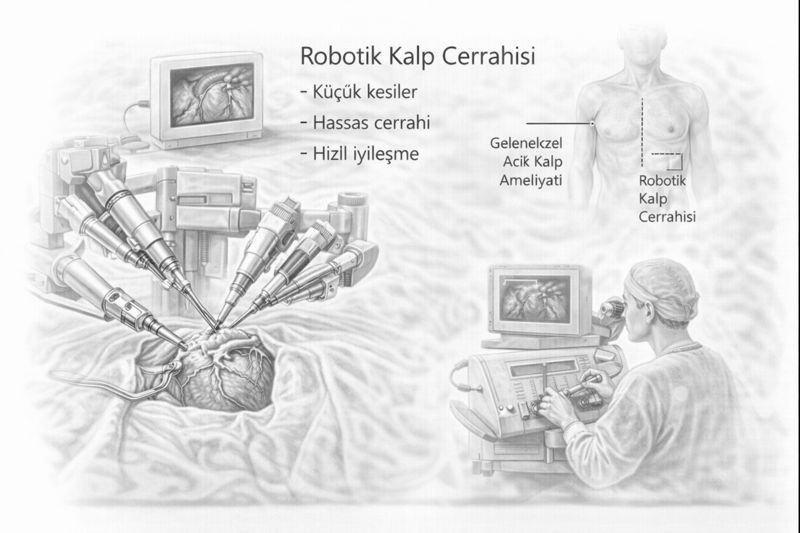
What is Robotic Cardiac Surgery?
Robotic cardiac surgery is a minimally invasive surgical method performed without completely cutting the breastbone (without sternotomy) or with much smaller incisions, using robotic arms and 3D high-resolution imaging. A cardiovascular surgeon always controls the system; the robot does not make decisions on its own. The goal is to safely intervene in the complex structures of the heart with millimeter precision, tremor-free movements, and an expanded field of view through smaller incisions.
How Does the Robotic System Work? “The Surgeon’s Extended Hands”
The robotic platform consists of three main components: the surgeon console, the patient unit (robotic arms), and the imaging system. The surgeon controls the robotic arms with hand controls and pedals at the console; movements are scaled, filtered, and tremors are eliminated.
Surgeon Console
The surgeon performs the operation while seated at an ergonomic console, viewing a 3D-HD image. Hand movements are transmitted to the robot; the system magnifies and refines these movements (e.g., a 5 mm hand movement can be reduced to 1 mm at the tip). This provides a significant advantage in procedures requiring micron-level precision, such as suturing and valve repair.
Patient Unit (Robotic Arms)
Robotic arms are inserted through trocars placed in small incisions in the chest wall. Each arm has different end-effectors (scissors, graspers, tissue dissectors, suturing devices, etc.). These arms, with 7 degrees of freedom, can operate at angles impossible for the human wrist, making suturing easier even in confined spaces.
Imaging System
A three-dimensional, high-resolution camera magnifies and displays the details of the heart and valve structures. The depth perception is richer compared to open surgery, which provides confidence in tasks such as rapid control of bleeding areas and symmetrical placement of sutures.
Applications in Cardiac Surgery
The robotic system is not suitable for every patient or every pathology; however, in appropriately selected cases, the following procedures can be successfully performed.
Robotic Mitral Valve Repair/Replacement
In patients with mitral valve insufficiency, mitral valve repair or replacement can be performed using robotic techniques. Precise imaging and suture control can increase valve repair rates.
Robotic Coronary Artery Bypass Grafting (CABG)
Robotic preparation of the left internal mammary artery (LIMA) and anastomosis to the target vessel through a mini-incision (MIDCAB/TECAB) is possible. In selected single-vessel diseases, it can provide shorter hospital stays and faster recovery.
Robotic Atrial Septal Defect (ASD) Closure
For ASD repairs, the heart is accessed through a small incision; a patch is sutured with robotic arms. This offers advantages in aesthetic results and pain control.
Robotic Atrial Fibrillation (AFib) Ablation
In selected AFib cases, closed-method ablation lines can be applied; if necessary, it can be combined with mitral valve intervention in the same session.
Other Applications
Tricuspid valve repair, certain tumor excisions, pericardial interventions, and some congenital anomalies can be performed with a robotic approach.
Advantages of Robotic Cardiac Surgery
- Minimal incision and less pain: Most procedures are performed with 2–3 cm incisions; there is no sternal incision.
- Shorter hospital stay: Rapid mobilization and discharge are possible in suitable patients.
- Less blood loss and reduced need for transfusion.
- Superior imaging and movement precision: 3D magnification and tremor filtering increase suturing accuracy.
- Aesthetic results: Small scars remain instead of large ones.
- Earlier return to work/activity: Restrictions are generally lighter as the breastbone is not cut.
Potential Disadvantages and Limitations
- Patient selection is critical: Multi-vessel disease, advanced calcification, previous surgeries, or anatomical constraints may reduce suitability.
- Duration and team experience: There is a learning curve; durations and results improve in experienced centers.
- Technology cost: Robotic systems and consumable costs are high; they may not be available in every center.
- Not suitable for all procedures: Some complex aortic surgeries or multiple revisions may still require classical surgery.
Recovery Process
Post-robotic surgery, pain management is easier for most patients; breathing exercises and short walks are initiated early. Since the breastbone is not cut, restrictions regarding heavy lifting and arm movements are generally lighter. Nevertheless, it is essential to follow the surgeon’s instructions regarding wound care, blood thinners, and activity plans.
Who is Suitable for Robotic Cardiac Surgery?
Suitability is determined by a Heart Team based on echocardiography, coronary angiography/CT, vascular structure, and overall health status. Mitral valve insufficiency, isolated LAD disease, selected ASD, and some AFib cases are good candidates for robotic surgery. Diabetes, obesity, lung function, and previous surgeries are evaluated during the decision-making process.
Summary: Frequently Asked Questions (FAQ)
Does a robot perform the surgery in robotic surgery?
Is the heart always stopped?
Is there less pain and scarring?
Are the results as reliable as classical surgery?
Do You Have More Questions About Robotic Surgery?
You can review our special page for answers to 25 other questions you may have about robotic cardiac surgery, including costs, insurance processes, risks, and operation details.
Conclusion
Robotic cardiac surgery is a modern option that offers advantages of smaller incisions, faster recovery, and high precision in appropriately selected patients. However, patient selection, the experience of the center and surgeon, and technological infrastructure are key factors determining the outcomes. Making decisions about your heart health with a heart team that will evaluate your condition in all aspects is the safest approach.


