
As technology transforms every aspect of our lives, it continues to revolutionize the healthcare sector. Smartwatches on our wrists are no longer just counting steps or showing notifications — they are evolving into medical assistants capable of detecting potentially fatal heart conditions.
A groundbreaking study published in early 2026 in the Journal of the American College of Cardiology (JACC) scientifically confirmed this reality. The Apple Watch demonstrated significantly superior performance in detecting Atrial Fibrillation (AF) compared to conventional methods.
So what is this “silent threat,” and what do these new research findings mean for us? Let’s take a closer look at the details.
The Hidden Threat: What Is Atrial Fibrillation (AF)?
Atrial Fibrillation is one of the most common cardiac arrhythmias. It occurs when the heart’s atria beat irregularly and rapidly
The most dangerous aspect of AF is that it is often “silent.” Many patients can experience this condition without feeling any palpitations or discomfort. However, the absence of symptoms does not mean it is harmless. Untreated AF can lead to blood clot formation in the heart, and if this clot travels to the brain, it increases the risk of stroke fivefold.
This is why early detection of AF — especially in high-risk individuals before symptoms appear — is of vital importance.
Groundbreaking Research: The EQUAL RCT Study
The randomized controlled trial published in January 2026, known as the “EQUAL RCT,” was designed to measure the effectiveness of wearable technologies in detecting this silent threat.
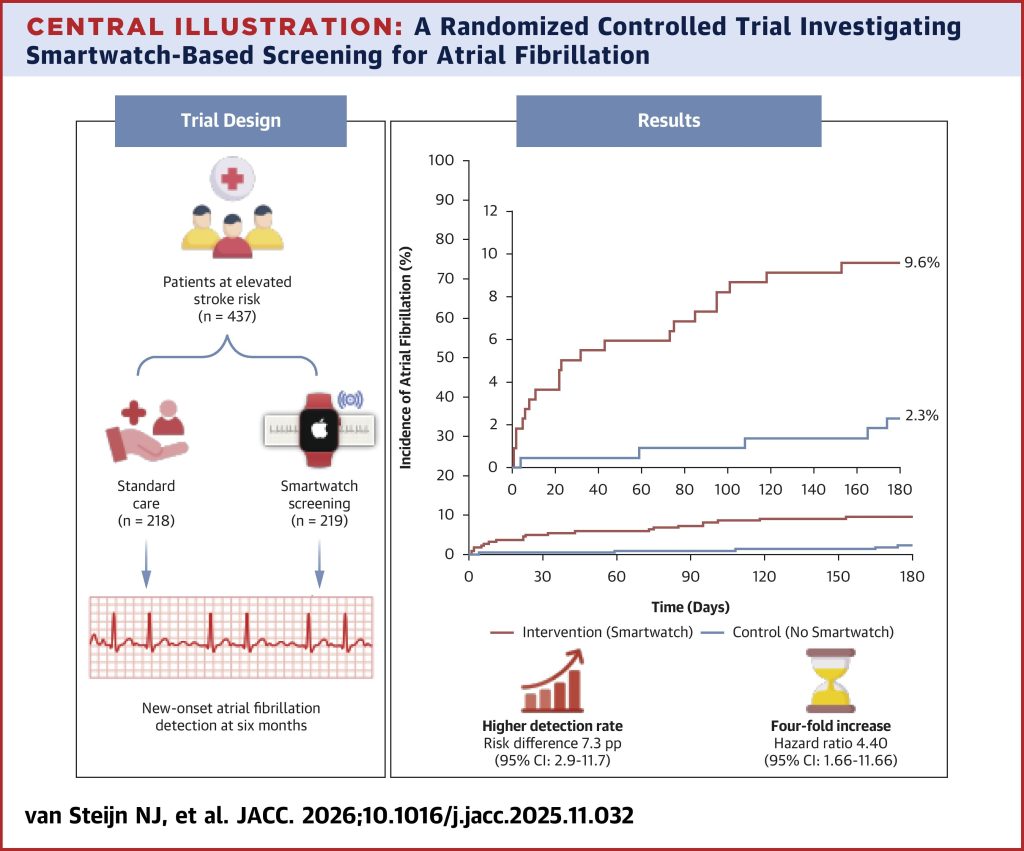
A total of 437 participants aged over 65 with high stroke risk were enrolled in the study. They were randomly divided into two groups:
- Standard Care Group: Participants who attended only routine medical check-ups.
- Digital Monitoring Group: Participants continuously monitored by wearing an Apple Watch for 180 days.
The smartwatch group was continuously monitored using the device’s optical heart sensors (PPG) and ECG feature. When irregular rhythm alerts were received, the data was reviewed and confirmed by a specialist e-Health team within 24 hours.
Striking Results: 4 Times More Diagnoses with Apple Watch
The data emerging at the end of the 180-day follow-up period made a significant impact in the cardiology world. The results demonstrated the overwhelming superiority of digital monitoring:
- Standard Care Group: New AF was diagnosed in only 2.3% of participants.
- Apple Watch Group: New AF was successfully detected in 9.6% of participants.
This result demonstrates that hidden cardiac arrhythmia was detected nearly 4 times more frequently and rapidly in high-risk individuals using a smartwatch compared to standard methods.
What Do These Results Mean?
This research proves that wearable health technologies are not merely popular gadgets. Apple Watch and similar advanced devices are clinically valid, life-saving screening tools, particularly for elderly and at-risk populations.
Every early-detected AF case means timely initiation of appropriate anticoagulant therapy, prevention of a potential stroke, and a life saved.
Conclusion: Your Health Is on Your Wrist
Technology offers us unparalleled opportunities for proactive health management. If you are over 65 or have cardiac risk factors, consult your doctor to learn how you can benefit from your smartwatch’s health features.
Remember, smartwatches cannot replace a visit to your doctor, but they can provide you with a vital clue about when you need to seek medical attention.
Academic References
The data in this article is based on the following scientific study:
- Study Title: Enhanced Detection and Prompt Diagnosis of Atrial Fibrillation Using Apple Watch (EQUAL RCT)
- Publication: Journal of the American College of Cardiology (JACC), January 2026.
- PubMed ID: 41569211
- DOI: 10.1016/j.jacc.2025.11.032
If you have concerns about your heart health, you can consult us by scheduling an appointment.
#notanad #clinicalresearch


